Runners, profiles and a bigger default brain: what changed in hal0 since 1.0
hal0 turns an AMD Strix Halo box, or any Linux machine with a GPU, an NPU or
just a CPU, into a private AI appliance you can reason about. Every model runs
in its own slot. Every tune lives in a named profile you can read, fork and
share. Every runner image is a pinned, hardware-gated build of upstream
llama.cpp or one of its peers. One OpenAI-compatible /v1 endpoint serves
chat, embeddings, rerank, speech, transcription and images.
Open WebUI, ComfyUI, a sandboxed Hermes agent and Hindsight memory come up already wired to each other. Signed updates converge the whole system and roll back with one flag. You own the hardware, the data and the config, and the config now says exactly what runs. The 1.0 GA was the starting line. This is what has landed since, with everything below traced to the changelog.
One name per runner
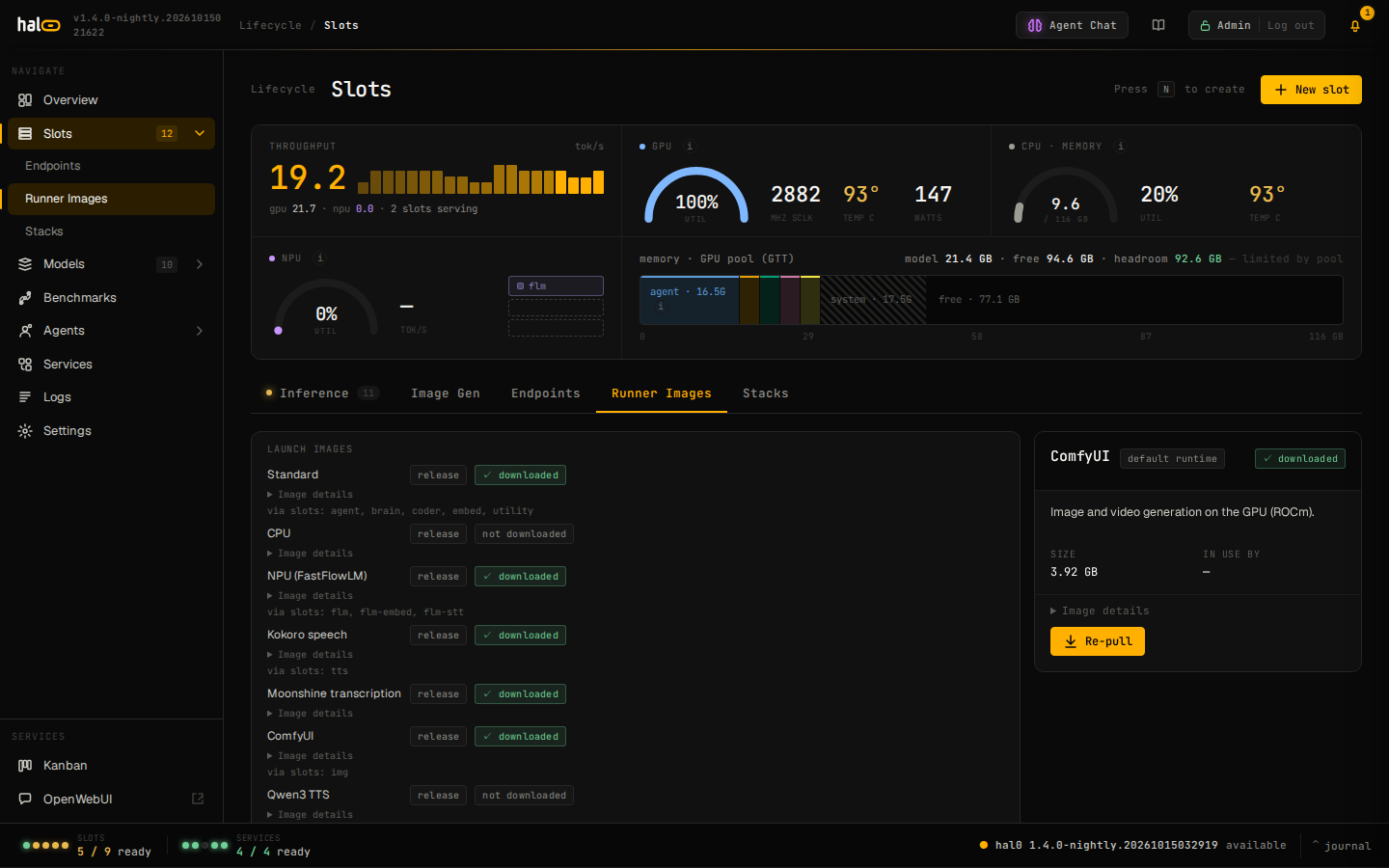
Section titled “One name per runner”A runner is the container build a slot launches. Each one now has a single name
that is used everywhere: the registry key, the pin, the catalogue row and the
package, ghcr.io/hal0ai/hal0-runner-<key>. The AMD llama.cpp runner is
Standard. It is built from pristine upstream llama.cpp and covers both ROCm
and Vulkan. CPU, FLM (the NPU), Kokoro, Moonshine and ComfyUI sit beside it as
default runners, with Qwen3 TTS and an NVIDIA CUDA image as optional extras.
Every image is pinned in one table in the release manifest, and each pin says
which hardware lanes it was gated on. The runner-image catalogue syncs itself
at startup and during hal0 update, so the page shows what is really on the
box rather than a stale list. The old image names are gone, along with the
FPX quant formats no shipped runner can load. Existing installs are converted
automatically.
Model is facts, profile is tune, slot is placement
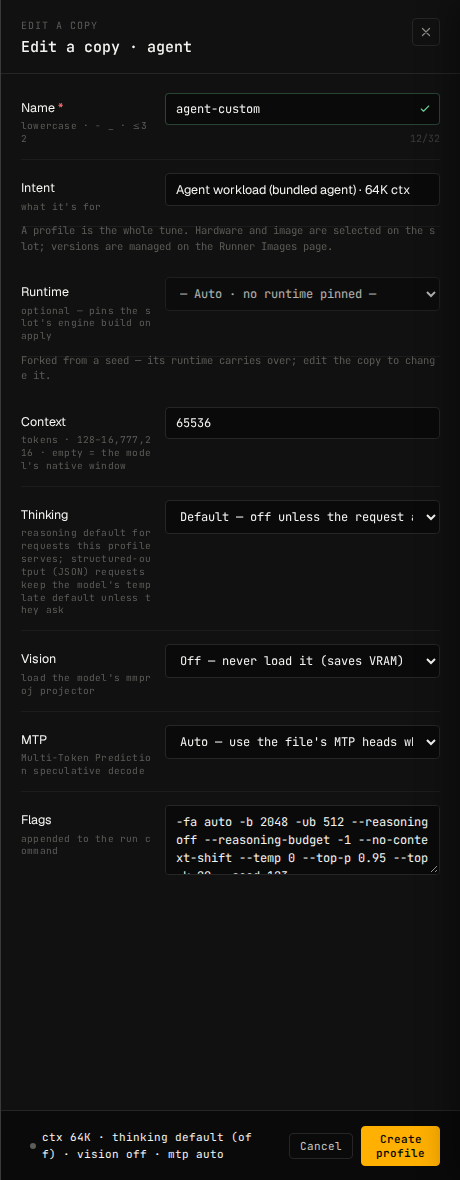
Section titled “Model is facts, profile is tune, slot is placement”This is the biggest change to how you configure hal0. A model row records only facts about its file: path, architecture, native context, chat template, projector, whether it has MTP heads. A profile holds every tune: flags, context size, thinking, vision and MTP. A slot holds placement: device, layers, threads, port, runner, and which model and profile it runs.
The practical result is that one model can run several ways. Put the same GGUF in two slots with two profiles, say a long-context one and a fast one, and nothing about the model changes. The launch command is composed in a fixed order (base, model, profile, slot) and the dashboard shows it layer by layer, so you can see which layer set which flag.
Existing configs are converted automatically, and the files are backed up under
/var/lib/hal0/backups/ before anything is rewritten. A slot the conversion
cannot place safely is marked blocked, with the reason and the fix on its card.
A bigger default brain
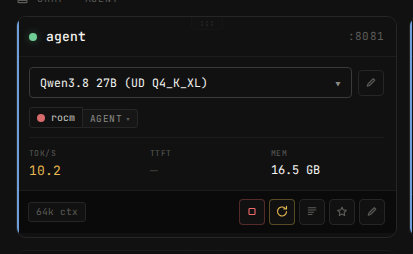
Section titled “A bigger default brain”A fresh install on a box with a 32 GB or larger memory pool now seeds Qwen3.8 27B (UD-Q4_K_XL, with vision) as the primary chat and agent model, at a 96K default context. Smaller boxes keep a 9B or 4B seed. hal0’s own always-on steward model, the brain, is LFM2.5 2.6B, small enough to leave running next to whatever else you load.
The bundled Hermes agent moves to 0.19 with smart command approvals. When it
wants to run a flagged shell command, your own local agent model looks at it
first. If that model does not clearly approve, Hermes falls back to asking you.
You can switch between smart and manual in Settings, or with
hal0 agent command-approvals.
Memory you can trust
Section titled “Memory you can trust”The bundled Hindsight engine is on 1.0. More important is what changed around it. Extraction used to run with defaults meant for a hosted API, 32 concurrent calls and 64000 tokens each, against a slot that serves one request at a time. On a slow box a write could return success and store nothing.
Now extraction has limits you set under Settings, Memory, and a write whose extraction slot is too small for the prompt is refused up front instead of vanishing. Writes land, or you are told why they did not.
Deleting a model follows the same rule. Removing one now removes its files by default, with guards and a keep-files opt-out, so a model you deleted no longer reappears after the next restart.
Wired before you log in
Section titled “Wired before you log in”Open WebUI comes up with document uploads going through RAG on hal0’s own embeddings, and its image button generating through ComfyUI, as soon as the slots are bound. Nothing to paste into a settings page. It keeps working when you turn key auth on, because the installer mints a client key for it.
Updates that finish the job
Section titled “Updates that finish the job”hal0 update is a signed tarball swap, and hal0 update --rollback puts the
previous tree back. It now also converges the components that ride along with a
release: Open WebUI, the runner images, Hermes and Hindsight. If a slot is
still running an old runner image after the update, hal0 restarts it, and the
command exits 2 while convergence is outstanding, so a script can tell “applied”
from “applied and finished”. You no longer end up with a new version running an
old build.
See it before you apply it
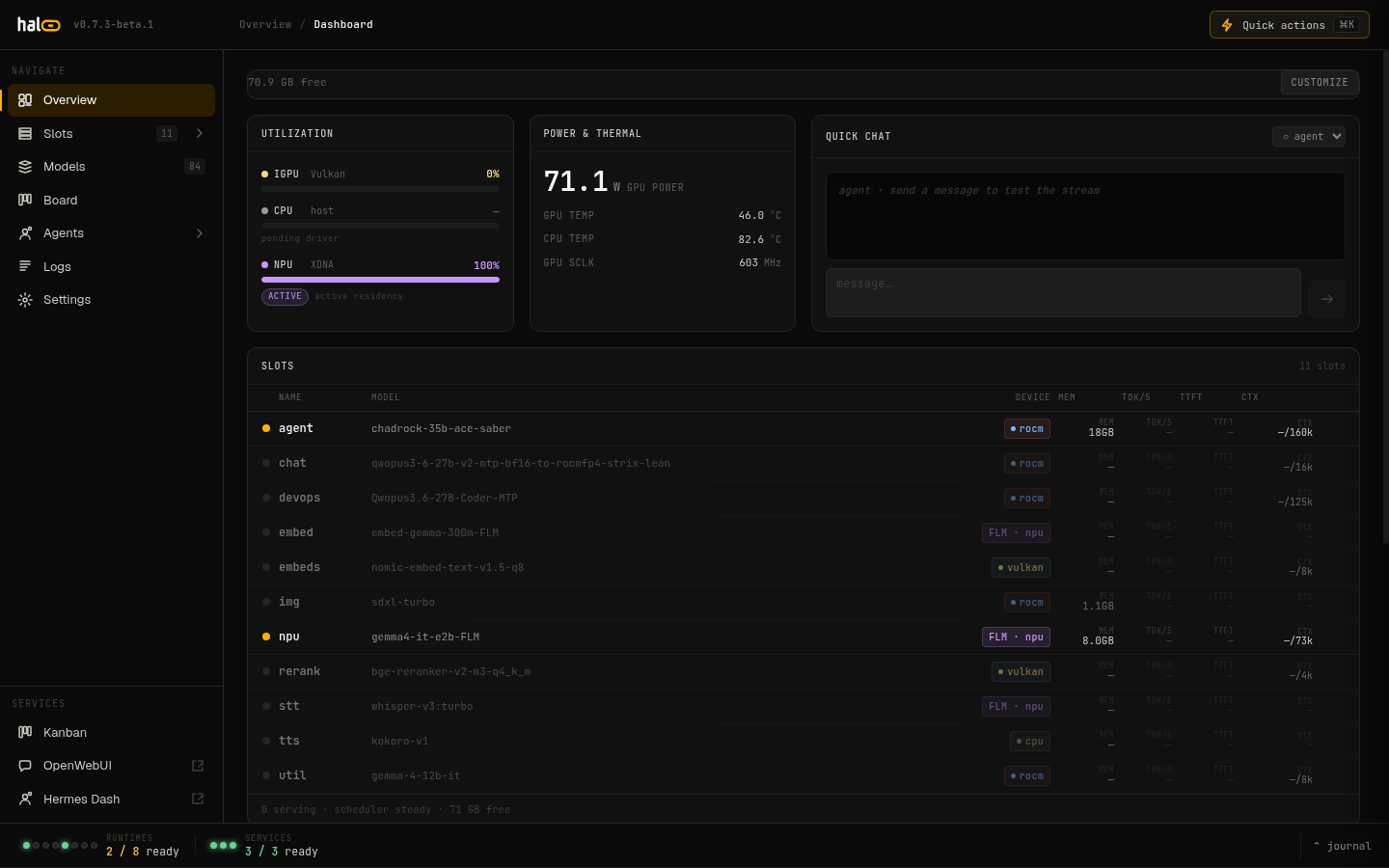
Section titled “See it before you apply it”A lot of the work has been about showing consequences before you click. Settings saves preview their exact diff. Applying a profile lists the runtime, flags and restart it will cause. Applying a stack tells you which slots it will unload. Model pickers carry a fit chip (fits, tight, won’t fit) based on the GPU memory the host reports right now, and when a container dies during load the decisive crash line shows up on the slot card instead of in a journal.
Safer by default on a LAN
Section titled “Safer by default on a LAN”hal0 still assumes a trusted network, so key auth is optional and off by
default. Once you have an admin key, off-box callers need it for admin routes.
Behind a reverse proxy, tell hal0 the public name with
hal0 network public-url set, or the origin check will refuse it. Login has a
30-day Remember me, and a lost admin key is recoverable with
sudo hal0 auth reset-key. Secrets are redacted more thoroughly in logs and
reports, and the /v1 proxy no longer forwards your session credentials to
whatever upstream it picks.
One thing has not changed: hal0 does not do TLS itself. Bring your own proxy.
Upgrading
Section titled “Upgrading”Run hal0 update. It verifies the signed tarball, shows the release notes
including any breaking changes and migrations before applying, swaps the tree,
runs the automatic conversions for runners and profiles, then converges
components and restarts slots whose runner image changed. Backups of anything
it rewrites go to /var/lib/hal0/backups/, and hal0 update --rollback returns
to the previous tree.
Questions, odd results or a conversion that blocked on your setup? Bring them to the forum.