Slot lifecycle reference
Every slot is a small state machine. The SlotManager drives transitions, the
dashboard SSE stream renders them live, and each transition is persisted
atomically to state.json. The dashboard shows real transitions — not systemd
snapshots.
States
Section titled “States”SlotState has nine values. Each value is also its JSON / SSE wire string.
| State | Wire value | Meaning |
|---|---|---|
OFFLINE | offline | Slot is not running. No systemd unit active. |
PULLING | pulling | Model files are downloading or being verified. Unit not yet started. |
STARTING | starting | systemd unit started; waiting for the container to come up. |
WARMING | warming | Container up; health probe returns non-ready while the model loads into VRAM / GTT. |
READY | ready | Passed the full health probe (non-empty /v1/models + sentinel completion). Ready to serve. |
SERVING | serving | An inference request is actively in-flight. |
IDLE | idle | Container up but cannot fulfil requests right now (see below). |
UNLOADING | unloading | Graceful shutdown in progress; waiting for the container to exit. |
ERROR | error | Slot has failed. Details in state.json and journald. |
The two faces of idle
Section titled “The two faces of idle”idle is reached two ways; both render identically on the wire but the state
machine arrives via different edges:
- Process up, no model (
warming → idle): the container is reachable but/v1/modelsis empty (e.g. launched with--model ""or the model file is missing). Routers must treat this distinctly fromready— never route an inference request to a slot that can’t fulfil it. - Warm but quiet (
ready → idle): a previously-ready slot received no request for longer than its idle timeout. A candidate for unloading.
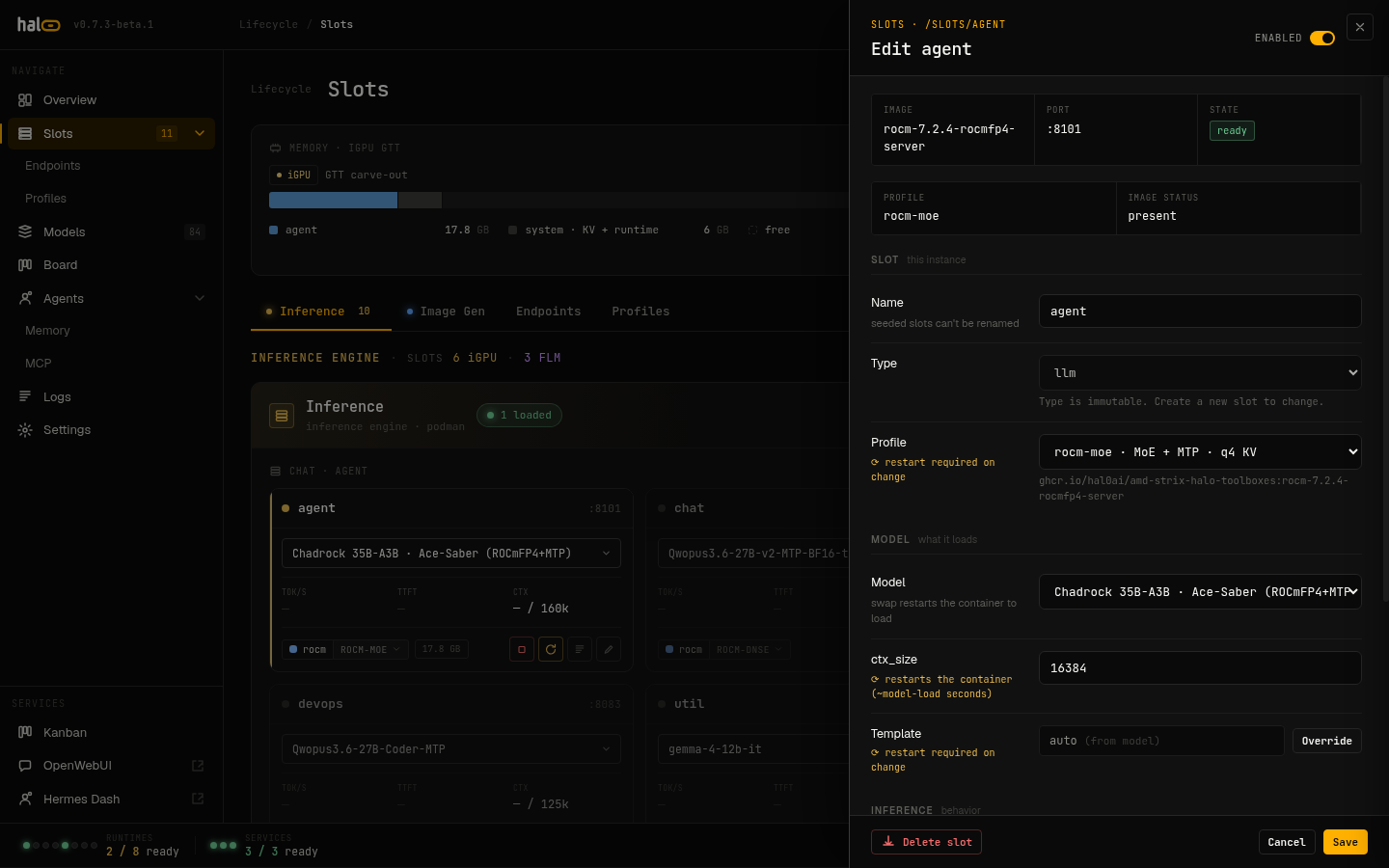 The slot detail panel in the dashboard, reflecting the current SlotState in real time.
Legal transitions
Section titled “Legal transitions”Transitions are enforced by the SlotManager; an illegal attempt raises
IllegalSlotTransition (HTTP 409).
| From | Allowed next states |
|---|---|
OFFLINE | PULLING, STARTING |
PULLING | STARTING, ERROR, OFFLINE |
STARTING | WARMING, ERROR, OFFLINE |
WARMING | READY, IDLE, ERROR, OFFLINE |
READY | SERVING, IDLE, UNLOADING, ERROR |
SERVING | READY, IDLE, ERROR |
IDLE | SERVING, UNLOADING, READY |
UNLOADING | OFFLINE, ERROR |
ERROR | OFFLINE, PULLING, STARTING |
The happy path is offline → pulling → starting → warming → ready, then
ready ↔ serving under load, drifting to idle when quiet, and
unloading → offline on teardown. error can recover back into offline,
pulling, or starting.
Failure detection — the fail-watcher
Section titled “Failure detection — the fail-watcher”While a slot sits in warming, ready, serving, or idle, a background
per-slot task polls the container unit’s systemctl is-active every 2
seconds:
warmingis judged purely on unit liveness — a big model load can legitimately hold/healthdown for minutes, so/healthis never consulted here. Three consecutive inactive polls flip the slot toerrorwith message"container unit died while warming".ready/serving/idleare judged on unit liveness and/health: an active-but-unhealthy unit (two consecutive failed/healthprobes) flips toerrorwith message"model server failed /health probe".- A unit that goes inactive cleanly — a GPU-arbiter handoff, a plain
systemctl stop, an OOM-kill pending restart — is reflected asoffline(message"container stopped (auto-reloads on next request)"), noterror. The rederrordot is reserved for genuine spawn/health/load failures; a clean stop is a normal condition the dispatcher lazily reloads on the next request.
Detection latency is therefore up to a few poll intervals (roughly 4-6 seconds), never instant.
Reaching ready without an explicit model
Section titled “Reaching ready without an explicit model”An NPU FLM slot of type = "transcription" or type = "embedding" is a
different case: a trio shadow. The NPU runs a single FLM process — the
device = "npu", type = "llm" anchor — which also serves transcription/
embedding when the anchor’s [npu] toggles are on. A shadow slot is not
independently loadable (a standalone load call on it 500s the single-tenant
NPU), so load() skips both the spawn and the readiness probe for it and
transitions it straight to READY with message "served by NPU FLM anchor (trio shadow)". Its live state is otherwise derived from the anchor, and
inference requests are dispatched to the anchor’s FLM process, never to the
shadow slot’s own (non-existent) port.
Idle eviction and wake-on-request
Section titled “Idle eviction and wake-on-request”Beyond the idle-timeout demotion to IDLE, a slot can be unloaded
(ready/idle → unloading → offline) two ways:
- Hard TTL. A slot idle past its resolved
idle_timeout_s(per-slot TOML override, else a 300-second default) is unloaded outright, freeing host RAM. An explicitidle_timeout_s = 0pins a slot against this. - Host-memory-pressure LRU eviction. When host
MemAvailabledrops below a configured floor, hal0 evicts idle,lru = true-flagged slots oldest-last_used-first until free RAM recovers (or no eligible slots remain). A slot actively serving a request is never evicted, andagent,utility, andnpuare never evicted by pressure regardless of theirlruflag — they’re the anchors the dispatch fallback chains depend on.
Either kind of eviction leaves the slot in OFFLINE, not ERROR — it’s a
resource-management transition, not a failure. A request that lands on an
idle-evicted slot triggers a lazy reload rather than a 404: the dispatcher
kicks off SlotManager.load() for the target slot and returns a structured
slot.loading 503 with Retry-After, so the client’s retry lands once the
slot is back up.
Fallback on load
Section titled “Fallback on load”If a slot’s configured model.default isn’t locally servable — deleted,
never pulled, or pulled-away — load() doesn’t just fail. It searches the
local registry for the best match by the slot’s capability (chat, embed,
rerank, asr, tts) and loads that instead, preferring name-similarity to the
configured id. Diffusion / image / video artifacts are always excluded from
this fallback search for a non-image slot, so a text slot can never silently
come up serving an image-gen model it can’t actually run.
Persistence — state.json
Section titled “Persistence — state.json”Each slot’s current state is stored as JSON at
/var/lib/hal0/slots/<name>/state.json. The record is intentionally flat for
human readability and written through an atomic same-directory tempfile +
os.replace, so an SSE reader or the dashboard never observes a half-written
transition.
| Field | Type | Notes |
|---|---|---|
name | str | Slot name. |
state | str | One of the wire values above. |
model_id | str | null | Currently-assigned model id. |
port | int | Host port. |
updated_at | float | Epoch seconds of the last transition. |
message | str | Human-readable detail (errors, notes). |
extra | object | Arbitrary extra metadata. |
A malformed state.json (missing/invalid state, unreadable file, bad JSON)
raises SlotConfigError rather than being silently swallowed.
Typed slot errors
Section titled “Typed slot errors”Slot operations raise typed errors so the API renders a structured envelope
with a stable slot.* code:
| Error | Code | HTTP |
|---|---|---|
SlotNotFound | slot.not_found | 404 |
IllegalSlotTransition | slot.illegal_transition | 409 |
SlotNotReady | slot.not_ready | 503 |
SlotSpawnFailed | slot.spawn_failed | 500 |
SlotHealthFailed | slot.health_failed | 503 |
SlotConfigError | slot.config_error | 400 |
NpuExclusivityViolation | slot.npu_exclusivity_violation | 409 |
NpuExclusivityViolation guards the AMD XDNA hardware context, which admits
exactly one NPU LLM at a time: two enabled device=npu, type=llm slots cannot
coexist.
Related references
Section titled “Related references”- hal0 CLI —
hal0 slot listreports these states. - Config schema — the per-slot TOML that defines a slot.
- Slots — the concept and dispatch model.